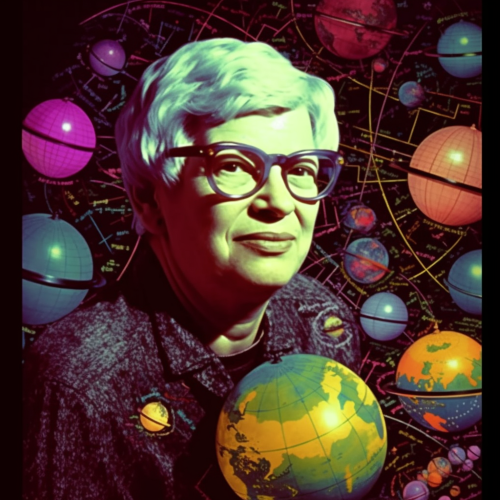
¶ Vera Rubin: The Mother of Dark Matter
¶ Introduction
Vera Cooper Rubin (1928-2016) was an American astronomer known for her groundbreaking work in the field of astrophysics. Her research fundamentally reshaped our understanding of the universe and played a pivotal role in unveiling the mysteries of dark matter. Despite her extraordinary contributions to science, Vera Rubin, regrettably, was not recognized with a Nobel Prize during her lifetime.
¶ Early Life and Education
Born in Philadelphia in 1928, Vera Rubin displayed an early fascination with the night sky, which led her to pursue a career in astronomy. She earned her bachelor's degree in astronomy from Vassar College in 1948 and continued her studies at Cornell University, where she completed her master's degree in 1951.
Rubin studied for her Ph.D. at Georgetown University, the only university in Washington, D.C., that offered a graduate degree in astronomy. In 1954, her doctoral thesis reached a groundbreaking conclusion: galaxies exhibited a tendency to cluster together rather than being dispersed randomly throughout the universe. This idea, considered highly controversial at the time, remained largely unexplored by the scientific community for a remarkable two decades.
During her years as a graduate student, she confronted discouraging instances of sexism. In a particularly disheartening incident, she was denied access to a meeting with the astrophysicist George Gamow because women were not allowed upstairs in the offices.
¶ Career and Research
Vera Rubin's career was marked by a relentless dedication to unraveling the secrets of the cosmos. One of her most influential contributions was her pioneering work on galaxy rotation curves. She observed that the outer regions of spiral galaxies did not obey the expected patterns of motion based on the visible mass alone. This observation led her to propose the existence of unseen, dark matter, which has since become a central concept in astrophysics.
Rubin's research challenged the prevailing paradigms of the time, and she continued to gather evidence to support her hypothesis throughout her career. Her work provided a compelling argument for the existence of dark matter, a substance that makes up a significant portion of the universe's mass and yet remains invisible to us.
¶ Legacy and Recognition
Despite her groundbreaking discoveries, Vera Rubin did not receive the Nobel Prize in Physics during her lifetime. This omission has been a subject of widespread debate and criticism within the scientific community. Many experts and advocates have argued that her contributions were deserving of this prestigious recognition, as her work fundamentally reshaped our understanding of the universe.
Vera Rubin's legacy extends beyond her scientific achievements. She became a role model for aspiring female scientists, breaking down barriers and inspiring generations of women to pursue careers in STEM fields. Her commitment to empowering women in science and her tireless dedication to unraveling the mysteries of the cosmos have left an indelible mark on the world of astronomy.
Sources: